Developing microblx blocks
Overview
Generally, building a block entails the following:
declaring configuration: what is the static configuration of a block
declaring ports: what is the input/output of a block
declaring types: which data types are communicated / used as configuration
declaring block meta-data: providing further information about a block
declaring and implementing hook functions: how is the block initialized, started, run, stopped and cleaned up?
reading configuration values: retrieving and using configuration from inside the block
reading and writing data from resp. to ports
declaring the block: how to put everything together
registration of blocks and types in module functions: make block prototypes and types known to the system
The following describes these steps in detail and is based on the
(heavily) documented random number generator block
(std_blocks/random/).
Note
Instead of manually implementing the above, a tool
ubx-genblock is available which can generate blocks including
interfaces from a simple description. See Generating blocks with
ubx_genblock.
Declaring configuration
Note
Since microblx v0.9, static block definitions must use
the “proto” types ubx_proto_config_t, ubx_proto_port_t and
ubx_proto_block_t to define prototype blocks. At runtime
(i.e. in hooks etc) the non-_proto_ versions are used as before
Configuration is described with a { 0 } terminated array of
ubx_proto_config_t types:
ubx_proto_config_t rnd_config[] = {
    { .name="min_max_config", .type_name = "struct random_config" },
    { 0 },
};
The above defines a single configuration called min_max_config of
the type struct random_config.
Note
custom types like struct random_config must be registered with
the system. (see section Declaring types.) Primitives (int,
float, uint32_t, …) are available from the stdtypes
module.
To reduce boilerplate validation code in blocks, min and max
attributes can be used to define the expected array length of
configuration values. For example:
ubx_proto_config_t rnd_config[] = {
    { .name="min_max_config", .type_name = "struct random_config", .min=1, .max=1 },
    { 0 },
};
These specifiers require that this block must be configured with
exactly one struct random_config value. Checking will take place
before the transition to inactive (i.e. before init).
In fewer cases, configuration takes place in state inactive and
must be checked before the transition to active. That can be
achieved by defining the config attribute CONFIG_ATTR_CHECKLATE.
Legal values of min and max are summarized below:
min |
max |
result |
|---|---|---|
0 |
0 |
no checking (disabled) |
0 |
1 |
optional config |
1 |
1 |
mandatory config |
0 |
CONFIG_LEN_MAX |
zero to many |
0 |
undefined |
zero to many |
N |
M |
must be between N and M |
Declaring ports
Like configurations, ports are described with a { 0 } terminated
array of ubx_proto_port_t types:
ubx_proto_port_t rnd_ports[] = {
    { .name="seed", .in_type_name="unsigned int" },
    { .name="rnd", .out_type_name="unsigned int" },
    { 0 },
};
Depending on whether an in_type_name, an out_type_name or both
are defined, the port will be an in-, out- or a bidirectional port.
Declaring block meta-data
char rnd_meta[] =
    "{ doc='A random number generator function block',"
    "  realtime=true,"
    "}";
Additional meta-data can be defined as shown above. The following keys are commonly used so far:
doc: short descriptive documentation of the blockrealtime: is the block real-time safe, i.e. there are no memory allocation / deallocation and other non deterministic function calls in thestepfunction.
Declaring/implementing block hook functions
The following block operations can be implemented to realize the blocks behavior. All are optional.
int rnd_preinit(ubx_block_t *b);
int rnd_init(ubx_block_t *b);
int rnd_start(ubx_block_t *b);
void rnd_stop(ubx_block_t *b);
void rnd_cleanup(ubx_block_t *b);
void rnd_preexit(ubx_block_t *b);
void rnd_step(ubx_block_t *b);
These functions will be called according to the microblx block life-cycle finite state machine:
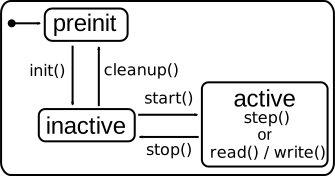
Block lifecycle FSM
The preinit and init hooks both run while the block is in
state preinit (so both may add or resize ports), but the
deployment applies configuration between them: preinit sees only
the static configuration, whereas init also sees the values of any
configs that preinit created. This lets a block grow its interface
in two dependent steps (see the launch sequence in
Composing microblx systems). ubx_block_init runs preinit
automatically, so a block that does not stage configuration need only
implement init.
The hooks are typically used for the following:
hook |
typical use |
|---|---|
|
extend the interface (add/resize ports, create configs) based on the static config values |
|
allocate memory and resources, open and initialize the device; check that it exists. Return zero if OK, non-zero otherwise |
|
become operational: enable the device, carry out last checks, cache port pointers, apply runtime configuration |
|
read from ports, compute, write to ports |
|
disable the device (often not used) |
|
deinitialize, close, free all memory and resources allocated in |
|
undo what |
Note
In most cases preinit and preexit are not required: a
block with a fixed interface only implements init..``cleanup``.
They are mainly for blocks with a very dynamic interface, whose
ports or configs depend on configuration values (e.g. one port per
configured channel).
Storing block local state
As multiple instances of a block may exists, NO global variables
may be used to store the state of a block. Instead, the
ubx_block_t defines a void* private_data pointer which can be
used to store local information. Allocate this in the init hook:
b->private_data = calloc(1, sizeof(struct random_info))

if (b->private_data == NULL) {
        ubx_err(b, "Failed to alloc random_info");
        goto out_err;
}
Retrieve and use it in the other hooks:
struct block_info *inf;

inf = (struct random_info*) b->private_data;
Reading configuration values
Configurations can be accessed in a type safe manner using the
cfg_getptr_<TYPE> family of functions, which are available for
all basic types. For example, the following snippet retrieves a scalar
int config and uses a default 47 if unconfigured:
long len;
const int *cfgval;
int value;

if ((len = cfg_getptr_int(b, "myconfig", &cfgval)) < 0)
    goto out_err;

value = (len > 0) ? *cfgval : 47;
Defining type safe configuration accessors for custom types can be achieved using the macros described in section Declaring type safe accessors.
The following example from the random (std_blocks/ubx/random.c)
block shows how this is done for struct min_max_config:
def_cfg_getptr_fun(cfg_getptr_random_config, struct random_config)

int rnd_start(ubx_block_t *b)
{
     long len;
     const struct random_config* rndconf;

     /*...*/

     /* get and store min_max_config */
     len = cfg_getptr_random_config(b, "min_max_config", &rndconf);

     if (len < 0) {
             ubx_err(b, "failed to retrieve min_max_config");
             return -1;
     } else if (len == 0) {
             /* set a default */
             inf->min = 0;
             inf->max = INT_MAX;
     } else {
             inf->min = rndconf->min;
             inf->max = rndconf->max;
     }
}
Like the first example, the generated accessor
cfg_getptr_random_config returns <0 on error, 0 if unconfigured,
or the array length (>0) if configured. If >0, rndconf points to
the actual configuration data.
Copy configs or use pointer directly?
In the above example, the configuration values are copied to the internal info struct. This is done to be able to assign defaults should no configuration have been given by the user. If this is not required (e.g. for mandatory configurations), it is perfectly OK to use the pointers retrieved via cfg_getptr… functions directly. The following table summarizes the permitted changes in each block state:
block state |
allowed config changes |
|---|---|
|
resizing and changing values |
|
changing values |
|
no changes allowed |
Due to possible resizing in preinit, config ptr and length should be re-retrieved in init.
When to read configuration: init vs start?
It depends: if needed for initalization (e.g. a char array describing
which device file to open), then read in init. If it’s not needed
in init (e.g. like the random min-max values in the random block
example), then read it in start.
This choice affects reconfiguration: in the first case the block has to
be reconfigured by a stop, cleanup, init, start
sequence, while in the latter case only a stop, start sequence
is necessary.
Reading from and writing to ports
Writing to ports can be done using the write_<TYPE> or
write_<TYPE>_array functions. For example:
/* writing to a port */
unsigned int val = 1;
write_uint(my_outport, &val);

/* reading from a port */
long len;
int val;

len = read_int(my_inport, &val);

if (len < 0)
       ubx_err(b, "port read failed");
       return -1;
else if (len == 0) {
       /* no data on port */
       return 0;
} else {
       ubx_info(b, "new data: %i", val);
}

...
For more see std_blocks/ramp/ramp.c.
Type safe read/write functions are defined for all basic types and
available via the <ubx.h> header. Defining similar functions for
custom types can be done using the macros described in
Declaring type safe accessors.
Declaring the block
The block aggregates all of the previous declarations into a single data-structure that can then be registered in a microblx module:
ubx_proto_block_t random_comp = {
    .name = "myblocks/random",
    .type = BLOCK_TYPE_COMPUTATION,
    .meta_data = rnd_meta,
    .configs = rnd_config,
    .ports = rnd_ports,

    .init = rnd_init,
    .start = rnd_start,
    .step = rnd_step,
    .cleanup = rnd_cleanup,
};
Declaring types
All types used for configurations or ports must be declared and registered. This is necessary because microblx needs to know the size of the transported data. Moreover, it enables type reflection which is used by logging or the webinterface.
In the random block example, we used a struct random_config, that is
defined in types/random_config.h:
struct random_config {
    int min;
    int max;
};
It can be declared as follows:
#include “types/random_config.h”
#include “types/random_config.h.hexarr”
ubx_type_t random_config_type = def_struct_type(struct random_config, &random_config_h);
This fills in a ubx_type_t data structure called
random_config_type, which stores information on types. Using this
type declaration the struct random_config can then be registered
with a node (see “Block and type registration” below).
Supported type system
Microblx registers types as named structs (TYPE_CLASS_STRUCT).
The header file associated with each struct is passed verbatim to
LuaJIT’s ffi.cdef at runtime. This imposes two rules on type
headers:
No
#includedirectives — LuaJIT’sffi.cdefdoes not run the C preprocessor. Use only C types that the LuaJIT FFI already knows (all standard integer types such asint,unsigned long,float,double, etc. are built-in;int32_t,uint8_tand the rest of the<stdint.h>family are also recognised natively).Keep one registered struct per header file. Auxiliary declarations (enums, helper unions) used only by that struct may appear in the same file. Do not define two independently registered structs in the same header.
The following constructs are all supported.
Plain struct (the common case):
/* types/my_point.h */
struct my_point { double x; double y; double z; };
Named enum used as a struct field:
The enum declaration must appear in the same header as the struct:
/* types/test_with_enum.h */
enum test_color { RED=0, GREEN=1, BLUE=2 };

struct test_with_enum {
    enum test_color col;
    int val;
};
Only one ubx_type_t is registered — for the struct:
#include “types/test_with_enum.h”
#include “types/test_with_enum.h.hexarr”
ubx_type_t t = def_struct_type(struct test_with_enum, &test_with_enum_h);
Enum fields are represented as numbers in Lua. When setting a config value from Lua or a USC model, symbolic string values are accepted and converted automatically by the LuaJIT FFI:
-- numeric and symbolic forms are equivalent:
{ name=”blk”, config = { color = 2 } }
{ name=”blk”, config = { color = “BLUE” } }
Named union used as a struct field:
/* types/test_with_union.h */
union test_variant { int i; float f; };

struct test_with_union {
    union test_variant v;
    unsigned char tag;
};
cdata.tolua converts the union to a Lua table containing all
members. A cdata.struct2tab hook (see cdata.struct2tab hooks)
can be registered to expose only the active member:
cdata.struct2tab[“union test_variant”] = function(cd)
    return tonumber(cd.i)   -- expose only integer member
end
Anonymous union inside a struct:
Anonymous union fields are promoted to the struct’s namespace by the
LuaJIT FFI. cdata.tolua promotes them to the top-level Lua table
as well:
/* types/test_with_anon_union.h */
struct test_with_anon_union {
    union {
        int   i;
        float f;
    };
    unsigned char selector;
};
Setting this type in a USC configuration works the same way:
{ name=”blk”, config = { value = { i=42, selector=0 } } }
Anonymous enum field inside a struct:
An anonymous enum used as a field type introduces its constants into the surrounding scope. The field is accessed and set like any other integer:
/* types/test_with_anon_enum.h */
struct test_with_anon_enum {
    enum { KIND_INT=0, KIND_FLOAT=1 } kind;
    int value;
};
As with named enums, symbolic strings are accepted in USC configs:
{ name=”blk”, config = { value = { kind=”KIND_FLOAT”, value=3.14 } } }
cdata.struct2tab hooks
For any named struct or union, a custom Lua→table converter can be
installed in the cdata.struct2tab table. The key must include the
C type keyword (”struct foo” or ”union bar”):
local cdata = require “cdata”

-- override default struct conversion
cdata.struct2tab[“struct test_with_enum”] = function(cd)
    local names = { [0]=”RED”, [1]=”GREEN”, [2]=”BLUE” }
    return { col = names[tonumber(cd.col)], val = tonumber(cd.val) }
end

-- select only the active union member
cdata.struct2tab[“union test_variant”] = function(cd)
    return tonumber(cd.i)
end
Anonymous structs and unions cannot be hooked because they have no name; register a hook on the containing struct instead.
Declaring type safe accessors
The following macros are available to define type safe accessors for accessing configuration and reading/writing from ports:
def_type_accessors(SUFFIX, TYPENAME)

/* will define the following functions */
long read_SUFFIX(const ubx_port_t* p, TYPENAME* val);
int write_SUFFIX(const ubx_port_t *p, const TYPENAME *val);
long read_SUFFIX_array(const ubx_port_t* p, TYPENAME* val, const int len);
int write_SUFFIX_array(const ubx_port_t* p, const TYPENAME* val, const int len);
long cfg_getptr_SUFFIX(const ubx_block_t *b, const char *cfg_name, const TYPENAME **valptr);
Using these is strongly recommended for most blocks.
Variants:
def_port_accessors(SUFFIX, TYPENAME)will define the port but not the config accessors.def_cfg_getptr_fun(FUNCNAME, TYPENAME)will only define the config accessordef_port_writers(FUNCNAME, TYPENAME)anddef_port_readers(FUNCNAME, TYPENAME)will only define the port write or read accessors respectively.
What is this .hexarr file
The file types/random_config.h.hexarr contains the contents of the
file types/random_config.h converted to an array const char
random_config_h [] using the tool tools/ubx-tocarr. This char
array is stored in the ubx_type_t private_data field (the third
argument to the def_struct_type macro). At runtime, this type
model is loaded into the luajit ffi, thereby enabling type reflection
features such as logging or changing configuration values via the
webinterface. The conversion from .h to .hexarray is done via
a simple Makefile rule.
This feature is very useful but optional. If no type reflection is
needed, don’t include the .hexarr file and pass NULL as a
third argument to def_struct_type.
Block and type registration
So far we have declared blocks and types. To make them known to the system, these need to be registered when the respective module is loaded in a microblx node. This is done in the module init function, which is called when a module is loaded:
1: static int rnd_module_init(ubx_node_t* ni)
2: {
3:        ubx_type_register(nd, &random_config_type);
4:        return ubx_block_register(nd, &random_comp);
5: }
6: UBX_MODULE_INIT(rnd_module_init)
Line 3 and 4 register the type and block respectively. Line 6 tells
microblx that rnd_module_init is the module’s init function.
Likewise, the module’s cleanup function should deregister all types and blocks registered in init:
static void rnd_module_cleanup(ubx_node_t *nd)
{
    ubx_type_unregister(nd, "struct random_config");
    ubx_block_unregister(nd, "ubx/random");
}
UBX_MODULE_CLEANUP(rnd_module_cleanup)
Real-time logging
Microblx provides logging infrastructure with loglevels similar to the
Linux Kernel. Loglevel can be set on the (global) node level (e.g. by
passing it -loglevel N to ubx-launch or be overridden on a per
block basis. To do the latter, a block must define and configure a
loglevel config of type int. If it is left unconfigured, again
the node loglevel will be used.
The following loglevels are supported:
UBX_LOGLEVEL_EMERG(0) (system unusable)UBX_LOGLEVEL_ALERT(1) (immediate action required)UBX_LOGLEVEL_CRIT(2) (critical)UBX_LOGLEVEL_ERROR(3) (error)UBX_LOGLEVEL_WARN(4) (warning conditions)UBX_LOGLEVEL_NOTICE(5) (normal but significant)UBX_LOGLEVEL_INFO(6) (info message)UBX_LOGLEVEL_DEBUG(7) (debug messages)
The following macros are available for logging from within blocks:
ubx_emerg(b, fmt, ...)
ubx_alert(b, fmt, ...)
ubx_crit(b, fmt, ...)
ubx_err(b, fmt, ...)
ubx_warn(b, fmt, ...)
ubx_notice(b, fmt, ...)
ubx_info(b, fmt, ...)
ubx_debug(b, fmt, ...)
Note that ubx_debug will only be logged if UBX_DEBUG is defined
in the respective block and otherwise compiled out without any overhead.
To view the log messages, you need to run the ubx-log tool in a
separate window.
Important: The maximum total log message length is 127 characters
(UBX_LOG_MSG_MAXLEN), so keep messages short or increase the limit
for your build.
Note that the old (non-rt) macros ERR, ERR2, MSG and DBG
are deprecated and shall not be used anymore.
Outside of the block context, (e.g. in module_init or
module_cleanup, you can log with the lowlevel function
ubx_log(int level, ubx_node_t *nd, const char* src, const char* fmt, ...)

/* for example */
ubx_log(UBX_LOGLEVEL_ERROR, ni, __FUNCTION__, "error %u", x);
The ubx core uses the same logger mechanism, but uses the log_info
resp. logf_info variants. See libubx/ubx.c for examples.
SPDX License Identifiers
Microblx uses a macro to define module licenses in a form that is both machine readable and available at runtime:
UBX_MODULE_LICENSE_SPDX(MPL-2.0)
To dual-license a block, write:
UBX_MODULE_LICENSE_SPDX(MPL-2.0 BSD-3-Clause)
It is strongly recommended to use this macro. The list of licenses can be found on http://spdx.org/licenses
Generating blocks with ubx_genblock
The ubx-genblock tool generates a microblx block including a
Makefile. After this, only the hook functions need to be implemented
in the .c file:
Example: generate stubs for a myblock block (see
examples/block_model_example.lua for the block generator model).
$ ubx-genblock -d myblock -c /usr/local/share/ubx/examples/blockmodels/block_model_example.lua
    generating myblock/bootstrap
    generating myblock/configure.ac
    generating myblock/Makefile.am
    generating myblock/myblock.h
    generating myblock/myblock.c
    generating myblock/myblock.usc
    generating myblock/types/vector.h
    generating myblock/types/robot_data.h
Run ubx-genblock -h for full options.
The following files are generated:
bootstrapautoconf bootstrap scriptconfigure.acautoconf input fileMakefile.amautomake input filemyblock.hblock interface and module registration code (don’t edit)myblock.cmodule body (edit and implement functions)myblock.uscsimple microblx system composition file, see below (can be extended)types/vector.hsample type (edit and fill in struct body)robot_data.hsample type (edit and fill in struct body)
If the command is run again, only the .c file will NOT be
regenerated. This can be overridden using the -force option.
Compile the block
$ cd myblock/
$ ./bootstrap
$ ./configure
$ make
$ make install
Launch block using ubx-launch
$ ubx-launch -webgraph -c myblock.usc
Run ubx-launch -h for full options. Browse to
http://localhost:8888 to see the running block graph.
Block Interface Guidelines
use
long(signed) for ubx type related lengths and sizes. This is sufficently large and errors can be returned as negative values (example:cfg_getptr_uint32).(i)blocks that allow configuring type and length of data to be handled should use the canonical config names
type_nameanddata_len.